
(ECNS) -- The forcible removal of Venezuela's elected president Nicolás Maduro by the U.S. military, followed by Maduro's transfer across borders to face what is presented as a judicial process, is, in the 21st century, a tragedy for humanity and a grotesque parody of the international order. Whatever the charges, whatever the justifications offered, such an act signals a readiness to abandon all restraint.

There is little reason to believe this will be the last such incident.
Why has such a tragedy occurred? Simply pointing fingers at the United States offers little analytical value. Since defeating Spain in the Spanish-American War of 1898, Washington has asserted dominance over the Western Hemisphere. In less than a century, it has orchestrated no fewer than 41 instances of regime change in Latin America.
Under banners such as counter-terrorism or anti-narcotics operations, coups have been planned, governments overthrown, and leaders detained. None of this is new.
What is new is the political timing. The operation aligns with President Donald Trump's effort to mark the 250th anniversary of the United States with a hardline interpretation of "Make America Great Again," while foreshadowing the political tone ahead of the 2026 mid-term elections.
Yet these factors are not the root cause. The deeper problem confronting the world today remains unaddressed: the persistence of what might be called the "three great evils" — imperialism, colonialism, and hegemonism — along with their domestic proxies. The UN Charter enshrines sovereign equality, yet when a state lacks the capacity to defend its sovereignty, that principle risks being reduced to little more than words on paper.
Indeed, this is a profoundly unbalanced world and the insignificant response from Europe following the seizure of Maduro makes this imbalance painfully clear. Its rhetoric toward Russia differs starkly from its tone toward the United States. And who is in a position to warn the U.S. against repeating such actions? President Trump has already singled out Colombia and Cuba with explicit warnings, raising concerns that Iran or Brazil under President Lula could be next.
Latin America's problems have long been diagnosed, and prescriptions have been written. Yet the region remains deeply unable to escape its predicament. At its core, Latin America continues to function as Washington's "backyard," living under the shadow of U.S. hegemony. "Too far from God, too close to the United States" is the enduring tragedy of the Americas.
Some Asian nations face a similar dilemma. A close reading of the recently released U.S. National Security Strategy further clarifies Washington's perspective: countries in the Americas are asked to choose "whether they want to live in an American-led world of sovereign countries and free economies or in a parallel one in which they are influenced by countries on the other side of the world."
Against this backdrop, Washington's move against Venezuela sends three unmistakable signals.
First, it demonstrates an intention to remove governments and leaders in the Americas that openly defy the U.S., not through targeted assassinations, but through highly public, humiliating judicial processes. The objective is meant to instill fear: who will be next?
Latin America is not merely Washington's "backyard"; this military operation signals the emergence of a Trump-version of the Monroe Doctrine. Order, justice, and security in the hemisphere will be defined by Washington. In short: "the Americas for the Americans."
Third, Venezuela's oil and strategic mineral resources — particularly those linked to the so-called "lithium triangle" (Argentina, Chile, Bolivia) countries— are assets the U.S. is determined to control. Securing supply chains at their source has become a central strategic priority to Washington. The consequence is that Latin America is left with little room to chart development paths aligned with its own national interests.
Venezuela's tragedy also illustrates a broader global regression: Washington is no longer concealing its intentions. The pursuit of hegemony in the Western Hemisphere is not an aberration, but a century-old tradition.
Even more worrying is the way that digitalization, networking, and intelligent technologies are further reinforcing new forms of U.S. digital colonialism and imperialism, extending dominance from the physical sphere into virtual space.
The author, Wang Yiwei, is director of the Institute of International Affairs at Renmin University of China. The views do not necessarily reflect those of ECNS.
(Translated by Evelyn)
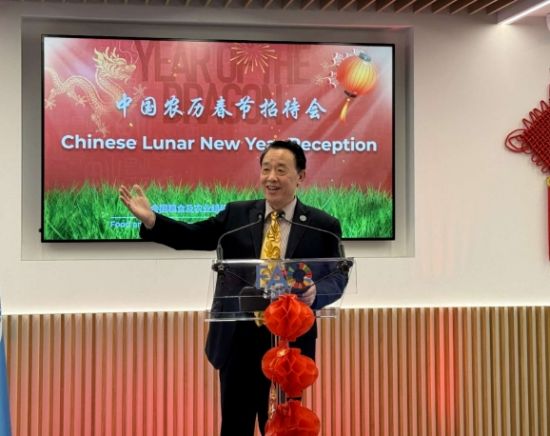
当地时间2月2日晚,联合国粮食及农业组织(粮农组织)在意大利首都罗马粮农组织总部举办中国农历春节招待会。多国驻意外交人员、意大利官员及粮农组织工作人员齐聚一堂,欢庆佳节。
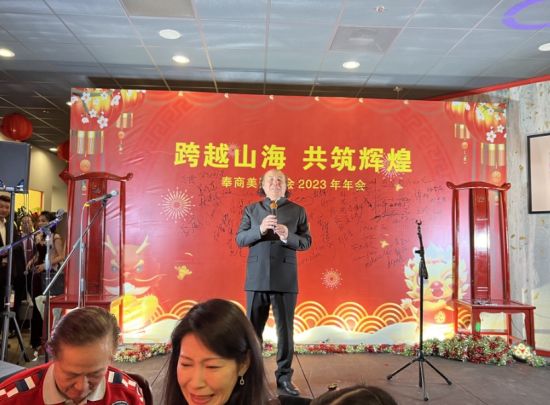
2024年1月31日,奉商美国总会在南加州工业市东北大饭店隆重举行了年会暨龙年新春联欢会,喜迎龙年新春。本次活动充满了浓厚的东北年味,活动内容丰富多彩,包括舞龙、送财神、民族舞蹈、乐器演奏等精彩节目,同时还有东北美食如小鸡炖蘑菇、东北大拉皮、血肠白肉酸菜等供应,让与会者尽情感受传统文化的魅力
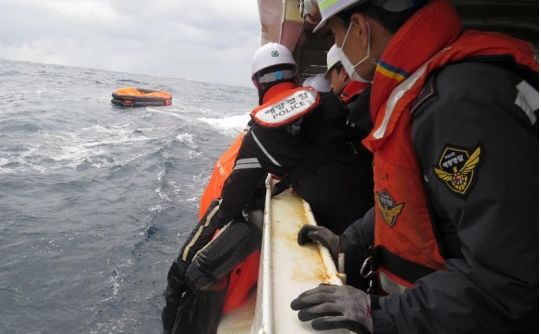
目前该艘中国货船已经于29日上午10时完全沉入海底。