
(ECNS) -- When German Chancellor Friedrich Merz walked into the showroom of Unitree Robotics in Hangzhou City of East China's Zhejiang Province on Thursday, he was greeted by a series of sublime robot performances.
This illustrates that the German government and German businesses are not only closely following China's cutting-edge digital economy innovations, but are also seeking better opportunities to cooperate with each other, said Sun Yanhong, director of the European Economic Research Office at the Institute of European Studies under the Chinese Academy of Social Sciences.

Germany has long been renowned for its world-class manufacturing, including mechanical engineering, automotive production, industrial software and automation. While their "Industry 4.0" strategy has guided industrial modernization for more than a decade now, rapid advances in algorithms, large AI models and intelligent hardware have accelerated so much that a new phase is required to move forward in these areas.
In recent years, China has leapt forward with its progress in robotics, intelligent manufacturing and AI deployment in various sectors. Its industrial ecosystem, from core components and system integration to large-scale production and commercialization, has helped them become global leaders. This in turn has intensified competitive pressure on Germany's traditional industrial pillars, including machinery and automotive manufacturing.
Data from Federal Statistical Office of Germany reflects these challenges they have. It shows that although Germany's GDP returned to growth last year after two consecutive years of contraction, manufacturing value-added still declined by 1.3% year on year, with particularly sharp drops in the automotive and machinery sectors.
Against this backdrop, China's importance to Germany continues to grow. Bilateral trade reached 251.8 billion euros ($272 billion) last year, up 2.1%, making China Germany's largest trading partner once again, surpassing the United States, according to the data.
Not only this, but data on trade structure highlights China's critical role in Germany's industrial ecosystem too. Official data show that Germany imported 13.9 billion euros worth of machinery from China, up 11.6% year on year. Imports of electrical equipment rose 14.8% to 32.8 billion euros, while the largest share of imports was for data processing equipment, electronics and optical products, reaching 50.9 billion euros.
These figures underscore China's dual role as both a key market and a crucial supply chain partner for helping Germany upgrade their industrial methods. Meanwhile, Chinese firms are rapidly moving up the value chain in sectors such as new energy vehicles, intelligent manufacturing and biomedicine, areas that were also traditionally dominated by many German companies.
Sun noted that while manufacturing competition between the two nations has intensified, there remains vast potential for cooperation in emerging sectors, including electric vehicles, intelligent manufacturing, and biotechnology.
Hu Chunchun, executive director of the Institute of European Studies at Shanghai International Studies University, said Germany should avoid overemphasizing de-risking narratives, warning that overstating security concerns could ultimately harm its economy.
Merz's stop in Hangzhou reflects these shifting dynamics, as he was accompanied by senior executives from around 30 German companies in various sectors such as automotive, chemicals, pharmaceuticals, machinery and circular economy sectors, reinforcing traditional strengths while positioning for future industries.
As Merz observed embodied intelligence technologies firsthand, the visit offered a glimpse not only of advanced robotics, but of the evolving future of manufacturing in today's world. For German industries, which are trying to navigate their own structural transformation, China's industrial advancement is no longer a distant development, but an increasingly important factor shaping its future.
(By Gong Weiwei)

当地时间2月2日晚,联合国粮食及农业组织(粮农组织)在意大利首都罗马粮农组织总部举办中国农历春节招待会。多国驻意外交人员、意大利官员及粮农组织工作人员齐聚一堂,欢庆佳节。
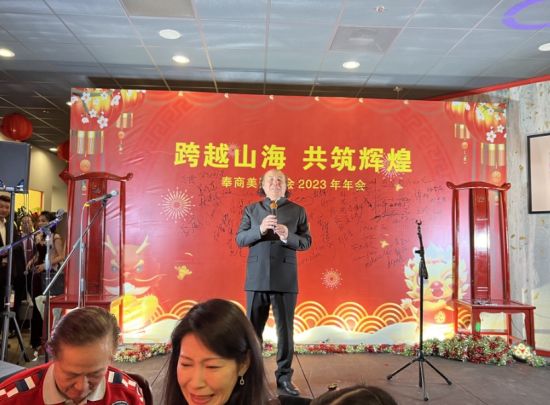
2024年1月31日,奉商美国总会在南加州工业市东北大饭店隆重举行了年会暨龙年新春联欢会,喜迎龙年新春。本次活动充满了浓厚的东北年味,活动内容丰富多彩,包括舞龙、送财神、民族舞蹈、乐器演奏等精彩节目,同时还有东北美食如小鸡炖蘑菇、东北大拉皮、血肠白肉酸菜等供应,让与会者尽情感受传统文化的魅力

目前该艘中国货船已经于29日上午10时完全沉入海底。